



Website Change Monitoring for SEO Performance


How Search Results Shape Brand Reputation (And How to Manage It)
Something changes on your site, and you don’t notice it right away. Then a few days later, performance starts to shift, and now you’re trying to figure out what happened. That’s a pattern most teams run into at some point, especially once a site reaches a certain level of complexity.
The challenge isn’t that changes are happening. It’s that they’re happening constantly, and not always in a way that’s easy to track or connect back to performance. So when something moves, whether it’s traffic, rankings, or conversions, you’re left piecing together what might have caused it after the fact.
Why diagnosing performance changes is harder than it should be
Most sites aren’t static, and they’re rarely managed by a single person or team. In larger organizations especially, too many people often end up touching the same pages over time. Content teams update copy, SEO teams adjust metadata, developers change templates, paid teams launch new landing pages, and sometimes those updates happen without a centralized record of what changed or why.
That’s usually where confusion starts, because when performance shifts later, nobody has a clean timeline to reference. Teams are left piecing together changes from memory, Slack threads, tickets, or scattered documentation.
Content gets updated, metadata is adjusted, templates evolve, and sometimes changes are pushed live without full visibility across stakeholders.
Individually, those updates don’t seem like much. But over time, they stack up, and when performance shifts, it becomes difficult to isolate what actually triggered the change. You end up relying on memory, Slack messages, or scattered documentation to reconstruct a timeline, which slows everything down and leaves room for error.
That’s usually where frustration comes in, because the data shows that something changed, but it doesn’t explain why.
Where most teams lose visibility
The biggest gap isn’t in analytics, it’s in context. You can see that a page dropped in rankings or that traffic spiked, but without knowing what changed on the page, it’s hard to explain the movement with confidence.
This is especially true when multiple updates happen close together. A content refresh, a title change, and a structural update might all go live within a short window, and without a clear record, it’s difficult to separate their impact.
That’s when teams either overreact or do nothing at all, because they don’t have enough clarity to make a decision.

What page monitoring actually is (and how it works)
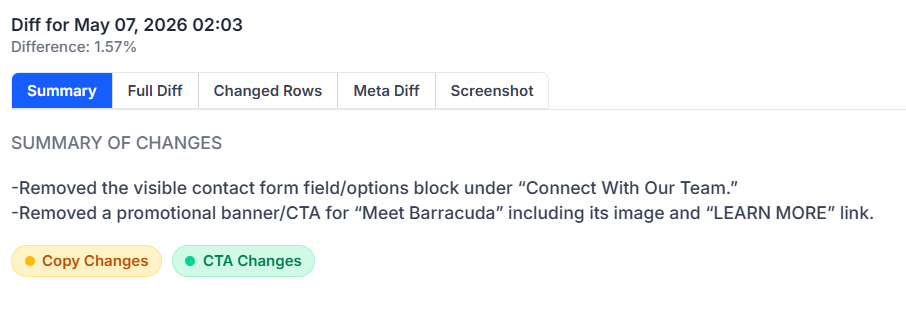
Page monitoring tracks changes to your site over time and connects those changes to performance data. Instead of trying to reconstruct what happened, you can see it directly, including what changed, when it changed, and how that aligns with shifts in rankings or traffic.
This includes updates to content, metadata, layout, and other on-page elements that influence how a page is evaluated. By capturing those changes consistently, page monitoring creates a timeline that makes it easier to understand cause and effect.
In practice, it becomes a searchable change log for your site. Instead of guessing when a page changed or trying to reconstruct updates manually, teams can quickly see what shifted and how those updates align with rankings, traffic, or conversion changes over time.
It’s less about tracking activity and more about adding context to performance.
Why this matters now, and what it looks like in practice
Performance doesn’t move randomly, even if it feels that way sometimes. There’s almost always a trigger, but without visibility into changes, that trigger is hard to identify.
Sometimes the impact shows up outside of SEO entirely. A dip in paid media performance, for example, can often be tied back to recent landing page updates, messaging changes, or structural adjustments that weren’t properly tracked. Without visibility into those changes, teams end up troubleshooting channels separately even though the root issue lives on the site itself.
That’s why page monitoring matters more as sites grow and teams become more distributed. The more moving parts you have, the harder it becomes to keep track of what’s happening without a system in place.
You can see how this plays out in environments where multiple updates are happening regularly. In our Clean Beauty Collective case study, being able to connect changes to performance made it easier to understand what was working and where to focus next. Instead of guessing, the team could make decisions based on a clear sequence of events.
That’s the shift.
When you can see what changed, you can respond faster, diagnose issues more accurately, and avoid repeating mistakes. It turns performance analysis from something reactive into something more controlled.
How this fits into a broader system
Page monitoring works best when it’s connected to the rest of your workflow. It doesn’t replace optimization or analysis, but it makes both more effective by adding the missing context.
It also creates visibility outside your own site. Monitoring competitor pages over time can reveal which messaging shifts, structural changes, or content updates are gaining traction, which gives teams a clearer sense of what’s actually working in the market instead of relying purely on assumptions.
Page Optimization helps you decide what to change, and page monitoring helps you see the changes over time . Content Similarity ensures those updates actually improve alignment with search intent, while Log Analysis shows how search engines respond to those changes at a crawl level.
You can explore how these pieces connect across the Barracuda Modules, and that’s where the system starts to come together. Each piece answers a different question, but together they create a clearer picture of performance.
Where to start
You don’t need to monitor every page at once. Start with a small set of high-impact pages and track changes over time, paying attention to how those updates align with performance shifts.
Even that limited view can surface patterns quickly, and once you start seeing those patterns, it becomes much easier to scale the process across the rest of the site.
Key takeaways
- Performance shifts are usually tied to changes, but those changes aren’t always visible.
- Without context, it’s difficult to explain why results move or how to respond.
- Page monitoring adds clarity by connecting updates to performance over time.
Frequently asked questions about page monitoring
What is page monitoring in SEO?
It’s the process of tracking changes to a page and connecting those updates to performance outcomes.
Why is tracking changes important?
Because even small updates can impact rankings, traffic, and conversions.
How does this help diagnose SEO issues?
It provides context, so you can see what changed before performance shifted.
Can page monitoring improve results?
Yes, because it helps teams identify what works and avoid repeating ineffective changes.
Where should I start?
Start by tracking a few key pages and comparing changes to performance over time.
Reach Out to Better Understand What’s Changing on Your Site
Performance shifts rarely happen without a reason. The challenge is knowing what changed, when it changed, and whether it actually impacted visibility, traffic, or conversions.
Barracuda Page Monitoring helps teams track website updates over time so they can diagnose issues faster, identify what’s working, and connect site changes directly to performance.
