


TikTok Ads Strategy for Performance Marketing: A Creative-First Playbook


A practical, creative-first playbook for CMOs and performance leaders using TikTok as a true acquisition channel. Learn how to structure testing and scale, design TikTok‑native creative, deploy Spark vs non‑Spark ads, choose targeting and bidding that hit CAC/ROAS goals, and build the operational systems that keep iteration speed high and costs efficient.
How TikTok Became a True Performance Channel, Not Just a Brand Play
TikTok has moved from a culture engine to a dependable acquisition channel for growth-stage and enterprise brands.
With massive time-on-platform and commerce features embedded across the journey, TikTok now drives measurable revenue when creative, measurement, and landing pages are aligned. The brands winning here are not chasing viral moments; they’re operationalizing creative testing to control CAC and expand profitable reach.
One of the biggest shifts in paid social over the past year is creative volume. Teams can now produce significantly more concepts, variations, and creator assets than they could even a year ago. The challenge is no longer simply producing more ads. It’s building systems that help teams organize, test, measure, and learn from that creative volume quickly enough to improve performance.
As a Badged Agency Partner with Tiktok, we treat performance creative as a core operating system, not a design afterthought. Creative has become the primary lever in paid social, especially on TikTok, because the algorithm increasingly optimizes to conversion signals within content. Our goal here is to show how to build the systems, feedback loops, and decision rules that turn TikTok into a reliable profit center.
Key Takeaways
Implement these moves up front to accelerate testing velocity and protect efficiency as you scale.
- Separate concept-testing campaigns from scale campaigns, run broad conversion-optimized ad groups, pace budgets to protect learning, align landing pages with your hooks and offers, and consolidate or split by objective, geography, or product line to grow efficiently.
- Favor broad or Smart Targeting so the algorithm learns from creative and conversion signals, use custom and lookalike audiences for retargeting and reactivation, and choose Cost Cap, CPA, or automated bidding to meet efficiency targets, moving to Maximum Delivery as winners prove scalable.
- Creator-style, low‑fi videos with strong visual and verbal hooks and clear on‑screen text in the first three seconds often outperform polished spots by stopping the scroll, lifting CTR, lowering CPC, and improving CAC and ROAS.
Why TikTok Works for Performance: Algorithm, Targeting, and Intent
TikTok’s For You Page is a dynamic recommendation engine that builds purchase intent through discovery. Rather than waiting for explicit search, TikTok’s content graph surfaces problem–solution stories, social proof, and comparisons that nudge users toward action while they browse.
That means acquisition can begin before the customer starts looking.
Because the delivery system learns quickly from real-time creative engagement and conversion signals, many high-performing teams minimize audience micro-targeting in favor of broad or Smart Targeting. This lets TikTok find pockets of demand you didn’t predict and scale winners with fewer constraints.
Custom and Lookalike Audiences still matter—but more for retargeting, reactivation, and feeding the algorithm with high-quality seed signals. The heaviest lift in prospecting often comes from your creative and landing page alignment, not from complex audience stacks.
When your ads clearly articulate the problem, promise, and proof—and your landing pages mirror the same hook, offer, and objection handling—TikTok can lower CAC by matching message to motivated scrollers at the moment attention is won.
- For You Page builds intent via discovery; prospects learn solutions while browsing, not just when searching.
- Broad and Smart Targeting help the system learn from creative and conversion signals rather than rigid audience definitions.
- Custom Audiences (e.g., site visitors, add-to-cart, purchasers) and Lookalikes excel at retargeting and reactivation.
- Lower CAC emerges when ad hooks and landing pages share the same promise, proof, and offer—reducing drop-off between click and conversion.
How Tiktok and Meta’s Algorithms Change Creative Strategy
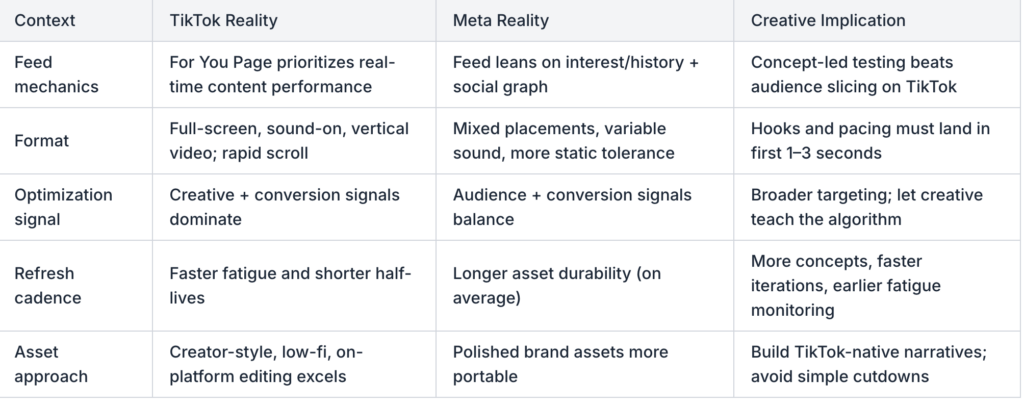
Although both platforms are pay-to-play performance channels, they optimize differently.
Meta leans more on explicit interest graphs and historical engagement, while TikTok relies heavily on real-time content performance in the For You Page. This shifts the leverage from audience definition toward creative signal quality.
TikTok’s full-screen, sound-on environment and rapid scroll mean the first seconds carry disproportionate weight. Hooks, pacing, and on-screen text must arrest attention and make the value prop unmistakable.
On Meta, users often browse in mixed contexts; on TikTok, your ad is the entire stage.
TikTok rewards frequent creative refreshes and concept diversity. Instead of pushing variations of a single hero asset, you’ll see more stability by testing multiple concept types—problem/solution, demos, comparisons, UGC testimonials, creator-led challenges—and then iterating deeper on the winners.
Brands underperform when they port polished Meta assets without adapting for TikTok’s cadence and narrative style. Treat TikTok creative as its own discipline with platform-native storytelling, not a resized cutdown of a brand spot.
How to Create Content that Feels Native on TikTok Feeds
Native-feeling on TikTok means creator-led framing, handheld or POV shots, quick cuts, and on-platform editing conventions. Language mirrors the feed—direct address, captions, and comments-as-copy—so the ad blends into the experience without losing a clear call to action.
“Creative is now the main lever in paid social, especially on TikTok, but what gets designed and what performs doesn’t always match.”
— Kimberly Anderson-Mutch, Director of Content, Go Fish Digital
The first three seconds set the outcome curve. Pair a visual hook (unexpected motion or transformation), a verbal hook (the one-sentence promise or tension), and bold on-screen text (mirroring the verbal hook) to stop the scroll.
If your prospect doesn’t hear or read the core benefit immediately, you’ve made conversion much harder.
Low-fi production isn’t about low quality. It’s about allocating attention to what matters: relevance, clarity, and proof. Creator-style content often beats polished ads because it feels like the feed, earns a longer watch time, improves CTR, and drives a more efficient CPC—the inputs that roll up to lower CAC and stronger ROAS.
What gets designed and what performs can diverge. Treat the first three seconds as sacred space: lead with the problem, the promise, or the proof, then earn the next three seconds with pacing, demonstrations, social proof, and fast cuts that keep retention high.
“Low-fi production is performing extremely well compared to traditional creative.” — Ethan Kramer, President of Social Commerce, Go Fish Digital
Building a Performance Creative System: Volume, Fatigue, and Concept Testing
Creative fatigue happens faster on TikTok due to rapid consumption and an algorithm that downranks stale content. Asset half-lives are shorter, so testing velocity and refresh cadence must be higher. Monitoring performance decay early—before CAC drifts—protects efficiency.
AI-assisted workflows changed the constraint from scarcity to volume. Teams can produce many more concepts and variations, but without systems for organization, measurement, and iteration, volume becomes noise. As Gregg Hecht notes, we can now create multiples more ads and test faster—but without systems, gains on one side create chaos on the other.
Focus on testing more concepts, not just more micro-variations. Once a concept shows strong signals (hook retention, CTR, CPC, early conversion density), iterate deeper: new hooks for the same core idea, alternate intros, different proof points, and fresh CTAs. That cadence compounds learning and extends winner lifespans.
High-performing TikTok teams are using increased production speed to test broader creative angles faster, not just endlessly tweaking the same ad. Problem-solution framing, creator testimonials, objections, demonstrations, comparisons, and offer positioning should all function as separate concept tests before iteration begins.
Customer interviews, reviews, and objections are higher-signal inputs than internal brainstorms alone. Pull the language customers use to describe pains and outcomes, highlight credible before/after proof, and turn common objections into creative angles and on-page FAQs that reduce friction.
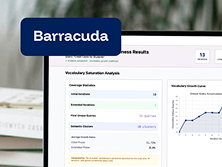
Go Fish Digital’s performance creative approach, supported by our Barracuda performance intelligence system, tracks concepts, tags hooks and proof types, flags fatigue, and routes learnings into next week’s shoots. The result: a durable, high-velocity feedback loop that finds winners earlier and retires losers faster.
- Organize creative by concept, not file name: problem/solution, demo, comparison, testimonial, offer, objection handling.
- Tag every ad with hook type (visual/verbal), proof element (UGC, expert, data, review), and CTA to enable apples-to-apples reads.
- Define promotion rules: X spend or X conversions at/below target CAC before moving from test to scale; deprecate on defined fatigue triggers.
- Log fatigue markers: falling thumbstop or CTR with rising CPC; rising frequency; creative age in days; comment sentiment shifts.
- Use AI to accelerate ideation, script drafting, and cutdowns, but gate with human QA for claim accuracy, brand safety, and compliance.
“We are able to do so much more than we were able to before… make two times, three times, four times as many ads, which means we can test in a way that we’ve never been able to and get data back much faster.”
— Gregg Hecht, VP of Performance, Go Fish Digital
Structuring TikTok Campaigns for Testing, Learning, and Scale
Separate your account into two main workstreams: concept testing and scale. Testing campaigns run broad conversion objectives with multiple, clearly labeled concepts. Winners graduate to scale campaigns with tighter budgets per ad group, fewer active concepts, and more predictable pacing. Deprecation rules remove underperformers quickly to protect learning.
Favor broad or Smart Targeting even in testing to let the algorithm learn from conversion signals. Avoid slicing audiences so thin that you stall learning. Use Custom and Lookalike Audiences for retargeting (viewed, clicked, site engaged) and reactivation (lapsed buyers), not for prospecting sprawl.
Budget pacing matters. Give testing ad groups enough runway to collect statistically useful data without overexposure; scale budgets only after consistent performance across several days or spend thresholds. Align landing pages to the ad hook and offer to reduce bounce, improve conversion rate, and stabilize CAC during scale-ups.
Consolidate campaigns when signals are strong and you need efficiency; split when objectives differ (conversion vs lead), geographies demand unique offers, or product lines require distinct messaging. Treat consolidation and splitting as levers for learning quality, not permanent structures.
Ad Formats, Spark vs. Non-Spark, Targeting, and Bidding for Performance
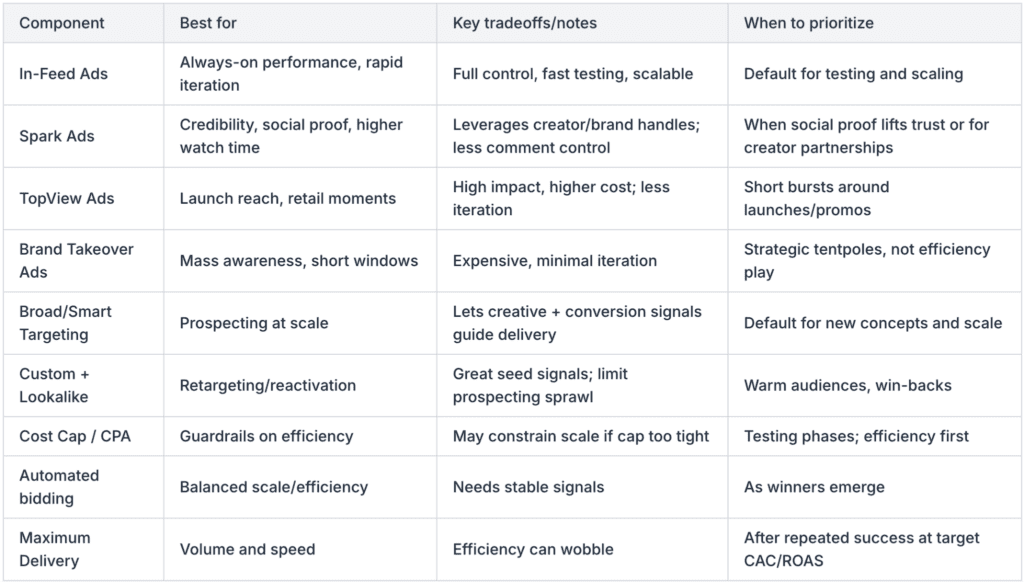
For performance, prioritize In-Feed Ads and Spark Ads. TopView and Brand Takeover can drive reach and search lift during launches or peak moments, but they’re rarely the starting point for efficient CAC. Keep your mix grounded in formats that allow rapid creative iteration and measurable conversion.
Spark Ads leverage existing organic or creator posts with native handles, comments, and social proof. They often deliver higher watch times and credibility, but you trade some control over comments and post persistence. Non-Spark Ads provide full control and rapid test velocity with ad-only posts—useful for early concept testing and strict offer/claim governance.
Targeting should be pragmatic: broad or Smart Targeting for prospecting; Custom and Lookalike Audiences for retargeting and reactivation. This setup lets the algorithm optimize to content and conversion signals while you keep audience segments clean for measurement.
Choose bidding to match your phase: Cost Cap or CPA bidding to guard efficiency during testing; automated bidding as learning stabilizes; and Maximum Delivery only once a concept proves scalable at or below target CAC/ROAS. Tie all of this back to creative testing velocity, formats, targeting, and bidding exist to help you identify winners early without overpaying for learning.

Metrics That Matter: Beyond Views and Engagement to CAC, ROAS, and MER
Views, likes, and comments don’t pay the bills if they don’t turn into efficient acquisition. Anchor on the metrics that map to contribution margin: thumbstop and hook retention as early signals; CTR and CPC as mid-funnel efficiency; and CAC, ROAS, MER, and payback period as final outcomes.
Thumbstop rate (how often users pause long enough to count as a view with intent) is your first read on hook strength. Track it alongside 2–3 second retention to see if the visual/verbals and on-screen text are doing their job. Use internal baselines and quartiles to decide if a hook is strong, average, or weak for your account.
Mid-funnel metrics connect attention to action. If CTR is high but CPC rises, you may be bidding into expensive pockets or your offer isn’t tight; if CTR is low but thumbstop is strong, fix the CTA clarity or landing page velocity. Down-funnel, judge creative by its contribution to CAC and ROAS, and watch MER to understand channel mix efficiency.
Use TikTok Ads Manager for in-platform signals, triangulate with attribution tools, and verify via post-purchase surveys. Go Fish Digital routes insights back into creative: poor thumbstop equals new hook; solid thumbstop but weak CTR equals stronger CTA or offer; strong CTR but weak conversion equals landing page and objection fixes.
- Early signals: thumbstop rate, 2–3s retention, first 25% watch.
- Mid-funnel: CTR, CPC, add-to-carts, view content.
- Outcomes: CAC, ROAS, MER, payback period, LTV:CAC.
- Decision rules: change hooks for weak thumbstop; sharpen CTAs/offers for weak CTR; fix landing pages when conversion lags.
Scaling Without Breaking: Common Mistakes and Cross-Channel Upside
Common pitfalls include over-indexing on one winner, ignoring fatigue, moving budgets too fast, and porting Meta-style creative without adapting hooks and pacing. Another frequent miss is message misalignment between ad and landing page, which inflates CPC-to-CAC leakage.
Build systems that flag performance shifts early so you can rotate concepts and rebalance budgets before CAC spikes. As Gregg Hecht cautions, without the right systems, you save time on production only to add complexity elsewhere. Treat fatigue management as an operations problem, not a creative whim.
The upside extends beyond TikTok. Fast feedback on hooks, offers, and objections can upgrade Meta and YouTube performance, inform SEO messaging, and improve onsite conversion. Creators, affiliates, and top customers become ongoing feedback loops for new angles.
Frequently Asked Questions
How should I structure TikTok campaigns to test, learn, and scale while keeping CAC and ROAS stable?
Split your account into concept-testing and scale campaigns. Test broadly with conversion objectives and multiple distinct concepts per ad group, promote only those that hit your CAC/ROAS gates, and retire losers quickly. Keep targeting broad or Smart, pace budgets to protect learning, and align landing pages to the ad’s hook and offer for smoother scaling.
Which targeting and bidding strategies should I use on TikTok to hit CAC and ROAS goals?
Use broad or Smart Targeting for prospecting so the algorithm learns from creative and conversion signals. Deploy Custom and Lookalike Audiences for retargeting and reactivation. Start with Cost Cap or CPA bids to guard efficiency; move to automated bidding as signals stabilize, and use Maximum Delivery only after repeated success at target CAC/ROAS.
What creative approach drives the strongest performance on TikTok?
Creator-style, low‑fi videos with strong visual and verbal hooks and bold on-screen text in the first three seconds consistently outperform polished cutdowns. Lead with a clear promise or tension, demonstrate quickly, layer social proof, and keep pacing tight to maintain retention and lift CTR—lowering CPC and improving CAC/ROAS.
Strong TikTok ads typically combine three elements immediately:
- A visual hook that interrupts scrolling.
- A verbal hook that frames the problem or promise.
- On-screen text that reinforces the value proposition instantly.
If one of those pieces is weak, retention usually drops before the core message lands.
When should I use Spark Ads vs non-Spark Ads?
Use non-Spark Ads for early concept testing and strict message control. Use Spark Ads to harness creator handles, comments, and social proof for added credibility once concepts show promise or when partnering with creators. Expect Spark to help watch time and trust; non-Spark to help speed and control.
How do I manage creative fatigue on TikTok?
Track fatigue markers: falling thumbstop and CTR with rising CPC, frequency drift, and negative comment sentiment. Build refresh cadences, test new hooks and intros for proven concepts, and rotate formats (demo, testimonial, comparison) to extend lifespans. Use a performance intelligence system to flag decay before CAC drifts.
TikTok Ads Strategy for Performance Marketing: A Creative-First Playbook
A practical, creative-first playbook for CMOs and performance leaders using TikTok as a true acquisition channel. Learn how to structure testing and scale, design TikTok‑native creative, deploy Spark vs non‑Spark ads, choose targeting and bidding that hit CAC/ROAS goals, and build the operational systems that keep iteration speed high and costs efficient.
How TikTok Became a True Performance Channel, Not Just a Brand Play
TikTok has moved from a culture engine to a dependable acquisition channel for growth-stage and enterprise brands.
With massive time-on-platform and commerce features embedded across the journey, TikTok now drives measurable revenue when creative, measurement, and landing pages are aligned. The brands winning here are not chasing viral moments; they’re operationalizing creative testing to control CAC and expand profitable reach.
One of the biggest shifts in paid social over the past year is creative volume. Teams can now produce significantly more concepts, variations, and creator assets than they could even a year ago. The challenge is no longer simply producing more ads. It’s building systems that help teams organize, test, measure, and learn from that creative volume quickly enough to improve performance.
At Go Fish Digital, we treat performance creative as a core operating system, not a design afterthought. Creative has become the primary lever in paid social, especially on TikTok, because the algorithm increasingly optimizes to conversion signals within content. Our goal here is to show how to build the systems, feedback loops, and decision rules that turn TikTok into a reliable profit center.
Key Takeaways
Implement these moves up front to accelerate testing velocity and protect efficiency as you scale.
- Separate concept-testing campaigns from scale campaigns, run broad conversion-optimized ad groups, pace budgets to protect learning, align landing pages with your hooks and offers, and consolidate or split by objective, geography, or product line to grow efficiently.
- Favor broad or Smart Targeting so the algorithm learns from creative and conversion signals, use custom and lookalike audiences for retargeting and reactivation, and choose Cost Cap, CPA, or automated bidding to meet efficiency targets, moving to Maximum Delivery as winners prove scalable.
- Creator-style, low‑fi videos with strong visual and verbal hooks and clear on‑screen text in the first three seconds often outperform polished spots by stopping the scroll, lifting CTR, lowering CPC, and improving CAC and ROAS.
Why TikTok Works for Performance: Algorithm, Targeting, and Intent
TikTok’s For You Page is a dynamic recommendation engine that builds purchase intent through discovery. Rather than waiting for explicit search, TikTok’s content graph surfaces problem–solution stories, social proof, and comparisons that nudge users toward action while they browse.
That means acquisition can begin before the customer starts looking.
Because the delivery system learns quickly from real-time creative engagement and conversion signals, many high-performing teams minimize audience micro-targeting in favor of broad or Smart Targeting. This lets TikTok find pockets of demand you didn’t predict and scale winners with fewer constraints.
Custom and Lookalike Audiences still matter—but more for retargeting, reactivation, and feeding the algorithm with high-quality seed signals. The heaviest lift in prospecting often comes from your creative and landing page alignment, not from complex audience stacks.
When your ads clearly articulate the problem, promise, and proof—and your landing pages mirror the same hook, offer, and objection handling—TikTok can lower CAC by matching message to motivated scrollers at the moment attention is won.
- For You Page builds intent via discovery; prospects learn solutions while browsing, not just when searching.
- Broad and Smart Targeting help the system learn from creative and conversion signals rather than rigid audience definitions.
- Custom Audiences (e.g., site visitors, add-to-cart, purchasers) and Lookalikes excel at retargeting and reactivation.
- Lower CAC emerges when ad hooks and landing pages share the same promise, proof, and offer—reducing drop-off between click and conversion.
How Tiktok and Meta’s Algorithms Change Creative Strategy
Although both platforms are pay-to-play performance channels, they optimize differently.
Meta leans more on explicit interest graphs and historical engagement, while TikTok relies heavily on real-time content performance in the For You Page. This shifts the leverage from audience definition toward creative signal quality.
TikTok’s full-screen, sound-on environment and rapid scroll mean the first seconds carry disproportionate weight. Hooks, pacing, and on-screen text must arrest attention and make the value prop unmistakable.
On Meta, users often browse in mixed contexts; on TikTok, your ad is the entire stage.
TikTok rewards frequent creative refreshes and concept diversity. Instead of pushing variations of a single hero asset, you’ll see more stability by testing multiple concept types—problem/solution, demos, comparisons, UGC testimonials, creator-led challenges—and then iterating deeper on the winners.
Brands underperform when they port polished Meta assets without adapting for TikTok’s cadence and narrative style. Treat TikTok creative as its own discipline with platform-native storytelling, not a resized cutdown of a brand spot.

How to Create Content that Feels Native on TikTok Feeds
Native-feeling on TikTok means creator-led framing, handheld or POV shots, quick cuts, and on-platform editing conventions. Language mirrors the feed—direct address, captions, and comments-as-copy—so the ad blends into the experience without losing a clear call to action.
“Creative is now the main lever in paid social, especially on TikTok, but what gets designed and what performs doesn’t always match.”
— Kimberly Anderson-Mutch, Director of Content, Go Fish Digital
The first three seconds set the outcome curve. Pair a visual hook (unexpected motion or transformation), a verbal hook (the one-sentence promise or tension), and bold on-screen text (mirroring the verbal hook) to stop the scroll.
If your prospect doesn’t hear or read the core benefit immediately, you’ve made conversion much harder.
Low-fi production isn’t about low quality. It’s about allocating attention to what matters: relevance, clarity, and proof. Creator-style content often beats polished ads because it feels like the feed, earns a longer watch time, improves CTR, and drives a more efficient CPC—the inputs that roll up to lower CAC and stronger ROAS.
What gets designed and what performs can diverge. Treat the first three seconds as sacred space: lead with the problem, the promise, or the proof, then earn the next three seconds with pacing, demonstrations, social proof, and fast cuts that keep retention high.
“Low-fi production is performing extremely well compared to traditional creative.” — Ethan Kramer, President of Social Commerce, Go Fish Digital
Building a Performance Creative System: Volume, Fatigue, and Concept Testing
Creative fatigue happens faster on TikTok due to rapid consumption and an algorithm that downranks stale content. Asset half-lives are shorter, so testing velocity and refresh cadence must be higher. Monitoring performance decay early—before CAC drifts—protects efficiency.
AI-assisted workflows changed the constraint from scarcity to volume. Teams can produce many more concepts and variations, but without systems for organization, measurement, and iteration, volume becomes noise. As Gregg Hecht notes, we can now create multiples more ads and test faster—but without systems, gains on one side create chaos on the other.
Focus on testing more concepts, not just more micro-variations. Once a concept shows strong signals (hook retention, CTR, CPC, early conversion density), iterate deeper: new hooks for the same core idea, alternate intros, different proof points, and fresh CTAs. That cadence compounds learning and extends winner lifespans.
High-performing TikTok teams are using increased production speed to test broader creative angles faster, not just endlessly tweaking the same ad. Problem-solution framing, creator testimonials, objections, demonstrations, comparisons, and offer positioning should all function as separate concept tests before iteration begins.
Customer interviews, reviews, and objections are higher-signal inputs than internal brainstorms alone. Pull the language customers use to describe pains and outcomes, highlight credible before/after proof, and turn common objections into creative angles and on-page FAQs that reduce friction.
Go Fish Digital’s performance creative approach, supported by our Barracuda performance intelligence system, tracks concepts, tags hooks and proof types, flags fatigue, and routes learnings into next week’s shoots. The result: a durable, high-velocity feedback loop that finds winners earlier and retires losers faster.
- Organize creative by concept, not file name: problem/solution, demo, comparison, testimonial, offer, objection handling.
- Tag every ad with hook type (visual/verbal), proof element (UGC, expert, data, review), and CTA to enable apples-to-apples reads.
- Define promotion rules: X spend or X conversions at/below target CAC before moving from test to scale; deprecate on defined fatigue triggers.
- Log fatigue markers: falling thumbstop or CTR with rising CPC; rising frequency; creative age in days; comment sentiment shifts.
- Use AI to accelerate ideation, script drafting, and cutdowns, but gate with human QA for claim accuracy, brand safety, and compliance.
“We are able to do so much more than we were able to before… make two times, three times, four times as many ads, which means we can test in a way that we’ve never been able to and get data back much faster.”
— Gregg Hecht, VP of Performance Creative, Go Fish Digital
Structuring TikTok Campaigns for Testing, Learning, and Scale
Separate your account into two main workstreams: concept testing and scale. Testing campaigns run broad conversion objectives with multiple, clearly labeled concepts. Winners graduate to scale campaigns with tighter budgets per ad group, fewer active concepts, and more predictable pacing. Deprecation rules remove underperformers quickly to protect learning.
Favor broad or Smart Targeting even in testing to let the algorithm learn from conversion signals. Avoid slicing audiences so thin that you stall learning. Use Custom and Lookalike Audiences for retargeting (viewed, clicked, site engaged) and reactivation (lapsed buyers), not for prospecting sprawl.
Budget pacing matters. Give testing ad groups enough runway to collect statistically useful data without overexposure; scale budgets only after consistent performance across several days or spend thresholds. Align landing pages to the ad hook and offer to reduce bounce, improve conversion rate, and stabilize CAC during scale-ups.
Consolidate campaigns when signals are strong and you need efficiency; split when objectives differ (conversion vs lead), geographies demand unique offers, or product lines require distinct messaging. Treat consolidation and splitting as levers for learning quality, not permanent structures.
Ad Formats, Spark vs. Non-Spark, Targeting, and Bidding for Performance
For performance, prioritize In-Feed Ads and Spark Ads. TopView and Brand Takeover can drive reach and search lift during launches or peak moments, but they’re rarely the starting point for efficient CAC. Keep your mix grounded in formats that allow rapid creative iteration and measurable conversion.
Spark Ads leverage existing organic or creator posts with native handles, comments, and social proof. They often deliver higher watch times and credibility, but you trade some control over comments and post persistence. Non-Spark Ads provide full control and rapid test velocity with ad-only posts—useful for early concept testing and strict offer/claim governance.
Targeting should be pragmatic: broad or Smart Targeting for prospecting; Custom and Lookalike Audiences for retargeting and reactivation. This setup lets the algorithm optimize to content and conversion signals while you keep audience segments clean for measurement.
Choose bidding to match your phase: Cost Cap or CPA bidding to guard efficiency during testing; automated bidding as learning stabilizes; and Maximum Delivery only once a concept proves scalable at or below target CAC/ROAS. Tie all of this back to creative testing velocity, formats, targeting, and bidding exist to help you identify winners early without overpaying for learning.
Metrics That Matter: Beyond Views and Engagement to CAC, ROAS, and MER
Views, likes, and comments don’t pay the bills if they don’t turn into efficient acquisition. Anchor on the metrics that map to contribution margin: thumbstop and hook retention as early signals; CTR and CPC as mid-funnel efficiency; and CAC, ROAS, MER, and payback period as final outcomes.
Thumbstop rate (how often users pause long enough to count as a view with intent) is your first read on hook strength. Track it alongside 2–3 second retention to see if the visual/verbals and on-screen text are doing their job. Use internal baselines and quartiles to decide if a hook is strong, average, or weak for your account.
Mid-funnel metrics connect attention to action. If CTR is high but CPC rises, you may be bidding into expensive pockets or your offer isn’t tight; if CTR is low but thumbstop is strong, fix the CTA clarity or landing page velocity. Down-funnel, judge creative by its contribution to CAC and ROAS, and watch MER to understand channel mix efficiency.
Use TikTok Ads Manager for in-platform signals, triangulate with attribution tools, and verify via post-purchase surveys. Go Fish Digital routes insights back into creative: poor thumbstop equals new hook; solid thumbstop but weak CTR equals stronger CTA or offer; strong CTR but weak conversion equals landing page and objection fixes.
- Early signals: thumbstop rate, 2–3s retention, first 25% watch.
- Mid-funnel: CTR, CPC, add-to-carts, view content.
- Outcomes: CAC, ROAS, MER, payback period, LTV:CAC.
- Decision rules: change hooks for weak thumbstop; sharpen CTAs/offers for weak CTR; fix landing pages when conversion lags.
Scaling Without Breaking: Common Mistakes and Cross-Channel Upside
Common pitfalls include over-indexing on one winner, ignoring fatigue, moving budgets too fast, and porting Meta-style creative without adapting hooks and pacing. Another frequent miss is message misalignment between ad and landing page, which inflates CPC-to-CAC leakage.
Build systems that flag performance shifts early so you can rotate concepts and rebalance budgets before CAC spikes. As Gregg Hecht cautions, without the right systems, you save time on production only to add complexity elsewhere. Treat fatigue management as an operations problem, not a creative whim.
The upside extends beyond TikTok. Fast feedback on hooks, offers, and objections can upgrade Meta and YouTube performance, inform SEO messaging, and improve onsite conversion. Creators, affiliates, and top customers become ongoing feedback loops for new angles.
Frequently Asked Questions
How should I structure TikTok campaigns to test, learn, and scale while keeping CAC and ROAS stable?
Split your account into concept-testing and scale campaigns. Test broadly with conversion objectives and multiple distinct concepts per ad group, promote only those that hit your CAC/ROAS gates, and retire losers quickly. Keep targeting broad or Smart, pace budgets to protect learning, and align landing pages to the ad’s hook and offer for smoother scaling.
Which targeting and bidding strategies should I use on TikTok to hit CAC and ROAS goals?
Use broad or Smart Targeting for prospecting so the algorithm learns from creative and conversion signals. Deploy Custom and Lookalike Audiences for retargeting and reactivation. Start with Cost Cap or CPA bids to guard efficiency; move to automated bidding as signals stabilize, and use Maximum Delivery only after repeated success at target CAC/ROAS.
What creative approach drives the strongest performance on TikTok?
Creator-style, low‑fi videos with strong visual and verbal hooks and bold on-screen text in the first three seconds consistently outperform polished cutdowns. Lead with a clear promise or tension, demonstrate quickly, layer social proof, and keep pacing tight to maintain retention and lift CTR—lowering CPC and improving CAC/ROAS.
Strong TikTok ads typically combine three elements immediately:
- A visual hook that interrupts scrolling.
- A verbal hook that frames the problem or promise.
- On-screen text that reinforces the value proposition instantly.
If one of those pieces is weak, retention usually drops before the core message lands.
When should I use Spark Ads vs non-Spark Ads?
Use non-Spark Ads for early concept testing and strict message control. Use Spark Ads to harness creator handles, comments, and social proof for added credibility once concepts show promise or when partnering with creators. Expect Spark to help watch time and trust; non-Spark to help speed and control.
How do I manage creative fatigue on TikTok?
Track fatigue markers: falling thumbstop and CTR with rising CPC, frequency drift, and negative comment sentiment. Build refresh cadences, test new hooks and intros for proven concepts, and rotate formats (demo, testimonial, comparison) to extend lifespans. Use a performance intelligence system to flag decay before CAC drifts.
Want to turn TikTok into a stronger acquisition channel?
Book a performance creative audit with Go Fish to see where your creative, media, and measurement systems are helping or hurting CAC and ROAS.
